A One-Two Cultural Punch: Colbert and Clooney Revive Trump’s Long Feud With Celebrity Criticism

New York — A convergence of late-night satire and celebrity political commentary this week placed former President Donald Trump once again at the center of America’s enduring argument over fame, power and political legitimacy, after remarks by Stephen Colbert and George Clooney circulated widely across television and social media.
The comments, delivered separately but amplified together online, did not introduce new allegations or policy claims. Instead, they drew backstage attention because of who made them — a leading late-night satirist and one of Hollywood’s most prominent political voices — and because they underscored how cultural figures continue to shape the tone of political debate outside traditional institutions.
Two Arenas, One Narrative
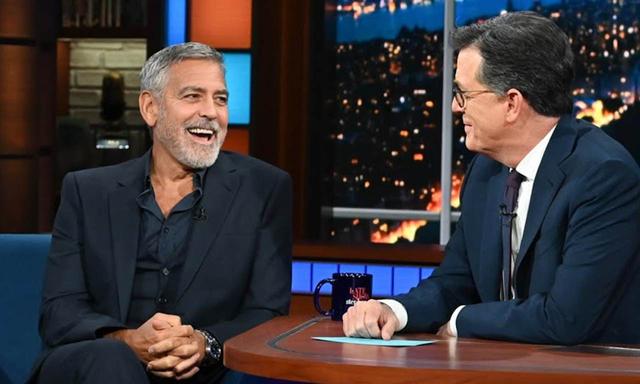
Mr. Colbert’s remarks came during a monologue on The Late Show with Stephen Colbert, where he referenced Mr. Trump’s recent public statements and legal posture, using irony and juxtaposition to highlight what he portrayed as contradictions. The segment relied on clips and reporting already in the public domain, framed for comedic effect.
Mr. Clooney’s comments emerged from a separate forum — an interview and public remarks tied to his long-standing advocacy on democracy and the rule of law. Clooney, who has supported Democratic candidates and humanitarian causes for years, criticized what he described as the normalization of attacks on democratic institutions, remarks that viewers and commentators quickly linked to Mr. Trump’s rhetoric.
Individually, neither moment was unusual. Together, they formed a cultural echo that traveled far beyond their original contexts.
The Celebrity–Politics Feedback Loop

Political scientists and media historians say such moments illustrate how American politics now unfolds across multiple stages at once.
“Presidents used to respond mainly to other politicians,” said Dannagal Goldthwaite Young, a professor at the University of Delaware who studies political humor. “Now they’re responding — or being forced to respond — to entertainers who reach millions instantly.”
Mr. Trump has long bristled at celebrity criticism, frequently accusing actors and comedians of elitism or irrelevance. During his presidency, he regularly attacked late-night hosts and Hollywood figures, framing them as part of a hostile cultural establishment.
That dynamic has not faded since he left office.
Reaction Without Confirmation
Mr. Trump did not issue a verified public response directly addressing the Colbert or Clooney remarks. Allies and critics alike filled the gap online, with supporters dismissing the commentary as partisan mockery and opponents portraying it as a devastating cultural rebuke.
Media analysts caution that such amplification often exaggerates impact.
“There’s a difference between viral framing and actual political consequence,” said Brian Stelter, a media analyst. “Social media turns moments into events.”
Why These Voices Still Matter
Mr. Colbert commands one of the largest audiences in late-night television, while Mr. Clooney remains one of the few actors whose political views consistently receive serious coverage. Research from the Pew Research Center suggests that younger Americans are more likely to encounter political ideas through entertainment platforms than through cable news.
That does not mean opinions are changed overnight. Most studies indicate that political comedy and celebrity commentary reinforce existing beliefs rather than convert skeptics.
“But reinforcement matters,” Young said. “It hardens narratives.”
Trump’s Media Strategy Under Strain

For Mr. Trump, the episode highlights a recurring dilemma: engaging with celebrity critics can extend their reach, while ignoring them allows narratives to circulate unchecked. His past responses have alternated between direct attacks and strategic silence.
Former advisers say the calculation is rarely clear-cut.
“When you’re the subject of the joke, there’s no clean win,” said a former Trump communications aide. “Respond and you validate it. Ignore it and you risk it sticking.”
A Broader Cultural Moment
The Colbert–Clooney convergence also reflects a broader shift in how opposition to political figures is expressed. Rather than formal speeches or policy critiques, much of today’s dissent arrives through humor, irony and cultural shorthand.
“This is how politics sounds now,” said Margaret Sullivan, a former public editor of The New York Times. “Less declarative, more performative.”
That performative quality can blur lines between entertainment and accountability, a tension critics of celebrity activism often raise. Supporters counter that cultural figures fill gaps left by weakened civic trust.
What It Does — and Doesn’t — Change
The remarks do not alter Mr. Trump’s legal cases, campaign strategy or standing with his core supporters. But they do contribute to an environment in which criticism is not confined to opponents in office or on the campaign trail.
Instead, it arrives from comedy stages and film festivals — places that command attention in a fragmented media landscape.
By the next news cycle, the immediate buzz had faded. But the pattern remains: when politics and celebrity collide, the result is less about policy than about narrative power.
In modern American life, that power is contested not only in elections and courtrooms, but in studios and spotlights — where influence is measured in laughs, headlines and shares.
And for figures as polarizing as Mr. Trump, those arenas are impossible to ignore.

Leave a Reply