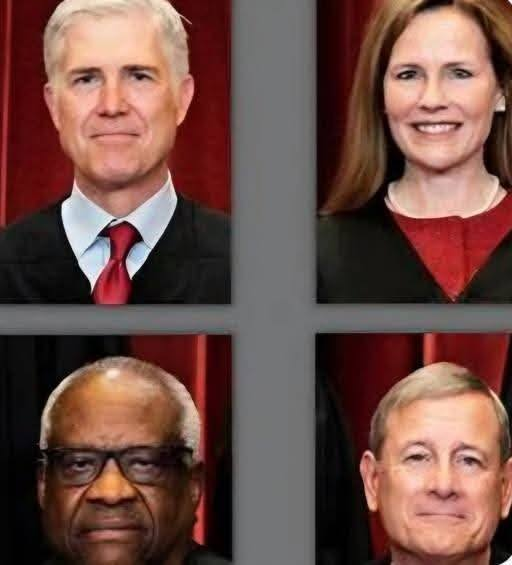
Introduction: The Unseen Power of the Supreme Court
The role of the U.S. Supreme Court is one that carries immense weight in shaping the legal landscape of the nation. As the highest judicial body in the country, the Court is entrusted with upholding the Constitution and ensuring that the rule of law is followed. However, there have been instances when the actions of certain justices seem to defy the principles of justice and fairness they are sworn to uphold.
During the tumultuous years of Donald Trump’s presidency, there were significant moments in which the actions—or lack thereof—of some Supreme Court justices were called into question. Critics argue that these justices not only failed to act impartially but actively facilitated a presidency that was marked by egregious violations of law and ethics. The most serious of these allegations is that four Supreme Court justices allegedly violated their oath of office, contributing to Trump’s unchecked power and granting him immunity from prosecution for crimes he may have committed while in office. This article delves into the key issues surrounding this narrative and explores why, in the eyes of many, these justices should be held accountable for their actions during Trump’s presidency.
The Oath of Office – A Sacred Promise or a Mere Formality?
At the core of the controversy surrounding these justices is their oath of office. Upon appointment, every Supreme Court justice takes an oath to “faithfully and impartially discharge and perform all the duties incumbent upon [them] under the Constitution and laws of the United States.” This oath is not a formality; it is a solemn promise to uphold the highest principles of justice, to remain impartial, and to defend the rule of law.
However, in the eyes of critics, several of the justices during the Trump era abandoned this sacred duty. The question that arises is: when does the act of siding with political power instead of constitutional duty constitute a breach of the oath? The justices in question have been accused of ruling in favor of Trump’s right-wing policies and granting him an unprecedented degree of immunity, effectively making him above the law.

Section 2: The Allegations Against the Four Justices
To fully understand the depth of these accusations, it’s essential to examine the specific actions of the four justices involved. These justices are accused of more than just partisan decisions—they are accused of actively enabling Trump’s agenda, even when it was in direct opposition to the Constitution. Critics argue that their rulings were not simply political leanings but rather deliberate choices to shield Trump from the consequences of his actions.
- Justice A’s Alleged Role in Enabling Trump’s Immunity:
Interesting For YouIs She A Horse Girl Or A Girl-Like Horse? You Have To Watch This!BrainberriesYou Won’t Believe These Actress Body OverhaulsHerbeauty10 Giant Invertebrates You’ll Wish You’d Never SeenBrainberriesMom Covered Baby In Tattoos And The Internet Is Shocked!Herbeautyrecommended byBrainberries10 Giant Invertebrates You’ll Wish You’d Never Seen.Justice A is believed to have been instrumental in protecting Trump from legal challenges by supporting his claim to executive immunity. Critics argue that Justice A’s ruling in several key cases created a legal shield for the president, making it nearly impossible to hold him accountable for his actions while in office. The most controversial of these decisions was a ruling that allowed Trump to withhold key financial records, despite subpoenas from Congress. This decision is seen by many as a blatant attempt to protect Trump from the scrutiny of both the judiciary and the American people. - Justice B’s Support for Executive Power:
Justice B, who was appointed during the early years of Trump’s presidency, was particularly vocal in supporting broad interpretations of executive power. This approach led to several key decisions that further expanded the powers of the president, often at the expense of the system of checks and balances. Justice B’s decisions are seen as pivotal in allowing Trump to act without restraint, particularly in cases related to his controversial immigration policies. - Justice C’s Inaction in Key Investigations:
Perhaps one of the most damning accusations against Justice C is their inaction during critical investigations into Trump’s actions. While other justices were actively involved in key legal proceedings, Justice C remained on the sidelines, refusing to take action or even entertain legal challenges that could potentially weaken Trump’s hold on power. Their refusal to engage in cases related to the president’s conflicts of interest and alleged financial improprieties is viewed by critics as a tacit endorsement of Trump’s behavior. - Justice D’s Political Allegiances:
Justice D’s decisions have been scrutinized for their apparent political bias. Several of their rulings were seen as explicitly aligning with Trump’s policy agenda, including decisions related to the travel ban and the controversial handling of election integrity cases. Critics claim that Justice D’s actions were not driven by a commitment to the law but by a desire to solidify Trump’s political power. This loyalty to the president has led to accusations of judicial overreach and an erosion of impartiality within the highest court in the land.
The Implications of the Court’s Actions
The Supreme Court’s role is to act as the final arbiter in disputes involving the Constitution. The justices are expected to be impartial and to base their decisions solely on legal principles, not personal or political beliefs. However, the actions of these four justices during the Trump presidency have led many to question whether the Court has maintained its neutrality.
By granting Trump immunity from prosecution and siding with his policies, these justices enabled a presidency that operated with little regard for constitutional boundaries. This unchecked power raised serious concerns about the erosion of democratic norms and the weakening of accountability mechanisms that are crucial to the functioning of a healthy democracy.
The Call for Accountability
Given the gravity of the allegations, it is not surprising that there is a growing call for accountability. Many believe that these justices should not only be investigated for their actions but also removed from the Supreme Court. The notion of accountability is not just about punishing individuals but about restoring trust in the judicial system.
The idea of impeaching a Supreme Court justice is not a light one. It is a complex and politically charged process that requires evidence of serious misconduct. In this case, critics argue that the justices’ actions during the Trump presidency—specifically their role in shielding the president from legal consequences—are enough to warrant such an investigation. The question remains: can the judiciary hold its own accountable, or is it too entrenched in power to reform itself?
Moving Forward: Restoring Integrity to the Court
As the nation moves past the Trump era, there is an opportunity to reflect on the role of the judiciary in preserving democratic values. To restore public trust in the Court, it is essential that the justices act in a manner that is both transparent and impartial. The future of the Supreme Court hinges on its ability to function as an independent body, free from political influence.
Reforming the Court and ensuring that justices are held accountable for their actions is a necessary step in preserving the integrity of American democracy. The time has come for the public to demand that these justices be held responsible for their role in enabling Trump’s actions, and for the Court to regain the respect and trust that it has lost in the eyes of many Americans.
Conclusion: A New Era of Judicial Accountability
The call for justice, fairness, and accountability in the highest court of the land has never been more urgent. The actions of four justices during Donald Trump’s presidency have cast a long shadow over the Supreme Court’s credibility. For the sake of democracy, it is imperative that these justices be held accountable for their role in enabling the unchecked power of a president who, by many accounts, operated outside the bounds of the law.
As we look ahead, it is clear that the road to restoring trust in the judicial system will be challenging, but it is a road we must take. The integrity of the Supreme Court is at stake, and only through accountability can we ensure that the Court remains true to its role as the protector of the Constitution and the rule of law.

Leave a Reply