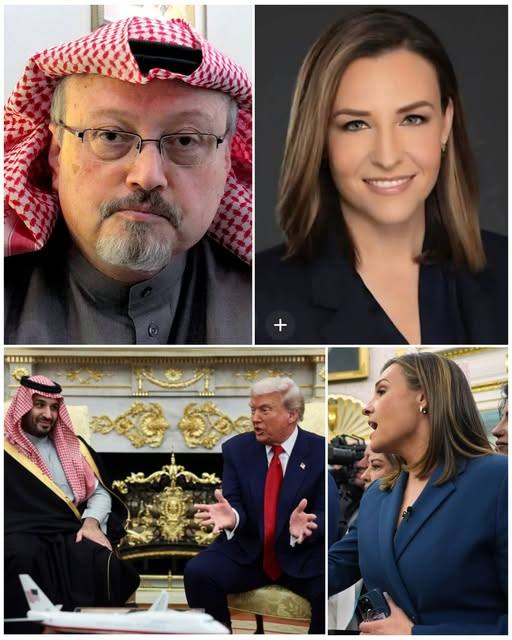
When Mary Bruce stood in the Oval Office and asked the uncomfortable questions about conflict of interest ties with Saudi Arabia, about the killing of Jamal Khashoggi, and about the hidden files of Jeffrey Epstein, she did not ask to provoke, but to illuminate. In return, Donald Trump lashed out. He mocked her, denounced her network as fake, and publicly called for the broadcast license of ABC News to be revoked.
Her composure in that moment matters. It sends a clear signal: accountability journalism is not optional when power is on the line. It is essential. And the reaction that followed is just as important. When the leaders of a democracy threaten to punish the press for doing their job, the integrity of that democracy itself is at stake.
Credit where it is due. Mary Bruce reminded the country that courage today often wears a press badge and a microphone. The deeper truth is that this moment was never just about one question or one reporter. It was about whether a free press can still ask what must be asked without fear of retaliation.
*Tony Pentimalli is a political analyst and commentator fighting for democracy, economic justice, and social equity. Follow him for sharp analysis and hard-hitting critiques on Facebook and BlueSky
When Mary Bruce Asked the Questions the White House Didn’t Want to Hear
In a moment that instantly ignited national debate, Mary Bruce stood in the Oval Office and did what journalists are meant to do: ask the questions others avoid. Her inquiries were direct, uncomfortable, and pointed at the heart of issues that have long shadowed American political discourse.
She asked about possible conflicts of interest involving Saudi Arabia.
She asked about the murder of journalist Jamal Khashoggi.
She asked about the sealed and undisclosed elements of the Jeffrey Epstein files.
Bruce’s tone wasn’t antagonistic — it was investigative. She was not there to provoke for spectacle; she was there to illuminate, to press for accountability, to make power explain itself.
But her questions were met with fury.
Trump’s Reaction: A Familiar Tactic
Rather than address the substance of her inquiries, Donald Trump responded with aggression. He mocked Bruce personally, dismissed her reporting, and labeled her network — ABC News — as “fake.” But this time, the confrontation didn’t end with rhetorical attacks.
Trump went further.
He publicly called for ABC News’ broadcast license to be revoked — a move critics immediately recognized as a dangerous attempt to undermine press freedom.
The confrontation sparked an uproar in journalistic circles. Veteran correspondents described it as “deeply chilling” for a sitting president to threaten a media outlet for asking valid, policy-related questions. Press freedom advocates warned that such rhetoric edges closer to authoritarian impulses than democratic norms.
The Questions That Echoed Across Washington
Mary Bruce’s inquiries were not random provocations; they reflected issues that Congress, intelligence officials, and international watchdogs have scrutinized for years:
- Saudi Arabia’s relationship with U.S. administrations has often raised ethical and geopolitical concerns.
- Jamal Khashoggi’s murder remains one of the most disturbing cases of state-directed violence against a journalist.
- Jeffrey Epstein’s network and sealed documents continue to raise questions the American public believes deserve transparency.
None of these subjects were new — but they were questions Trump had grown adept at avoiding. Bruce simply refused to let them be brushed aside.
Why the Moment Matters
For many Americans watching, the clash was bigger than a heated exchange.
It was about the role of journalism itself.
In democracies, the press is not meant to comfort the powerful — it is meant to hold them accountable. Mary Bruce’s insistence on asking the most difficult questions reminded the country why free media exists in the first place.
Her composure stood in stark contrast to Trump’s escalation. Even as he lashed out, she remained steady, notebook in hand, unwavering.
A Flashpoint for Press Freedom
Legal scholars quickly pointed out that no president has the authority to revoke a network’s broadcast license. Still, the mere call for it sent shockwaves through newsrooms across the nation.
To threaten the existence of a news outlet because of unwanted questions is not just unpresidential — it is a warning sign.
A warning about how fragile democratic norms can become when leaders see accountability as an attack rather than a duty.
The Legacy of a Question
Mary Bruce left the Oval Office that day not with answers, but with something just as powerful:
proof that real journalism still exists.
Her questions reverberated far beyond the room — across Washington, across media platforms, and across a nation still struggling to define the boundaries between truth, power, and responsibility.
And in the end, her act of courage reminded everyone watching that sometimes the most important thing a journalist can do is simply ask the question anyway.

Leave a Reply