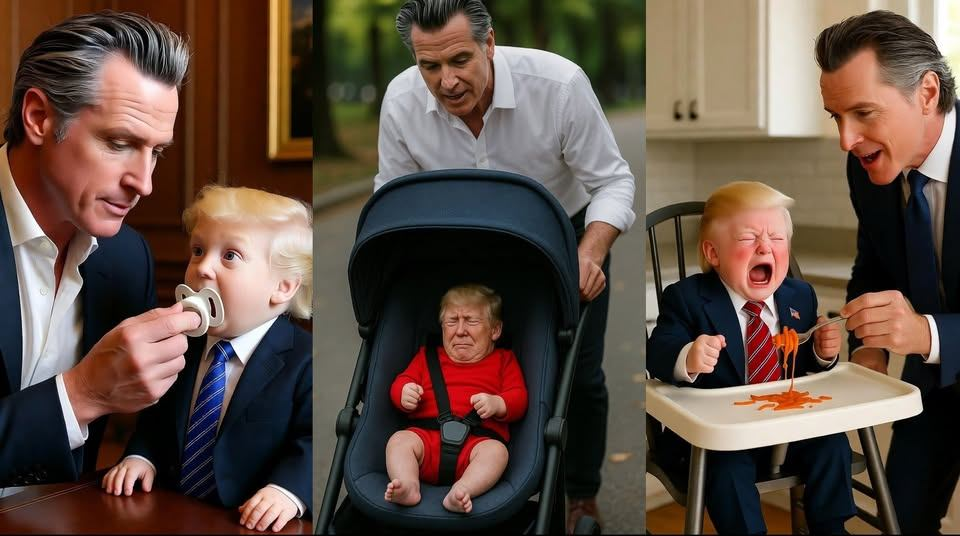
In the world of digital art and political satire, creators often use exaggeration and humor to reflect public moods, tensions, or opinions. The image series circulating online—featuring a suited adult man caring for a baby with a familiar hairstyle—is a bold example of how satire can simplify complex political narratives into visual storytelling.
These scenes portray the adult as a calm, composed figure attempting to manage a crying, tantrum-prone child dressed in formal attire. Whether offering a pacifier, pushing a stroller, or feeding spaghetti, the artwork transforms political rivalry and power struggles into humorous parental situations. The baby, depicted with an exaggerated pout and dramatic emotional reactions, symbolizes immaturity, stubbornness, and the chaos often associated with high-stakes political drama.
Symbolism Behind the Art
This kind of satire typically aims to convey several ideas:
1. Power Reduced to Playfulness
By presenting political conflict through the lens of childcare, the artist strips away formality and ego. Suddenly, campaigns, debates, and public disputes resemble the everyday challenges of calming a cranky child.
2. Commentary on Emotional Behavior
The crying child visually represents behaviors critics often highlight in political figures—impulsiveness, emotional reactions, or refusal to accept situations calmly. Satire exaggerates these traits to make a point.
3. The “Responsible Adult” Contrast
The adult figure, patient and composed, represents the idea of steady leadership. Whether intended positively or negatively depends on the viewer, but the contrast creates the humor that makes the image memorable.
4. Politics as Parenting
The imagery suggests that modern politics sometimes feels less like a clash of ideas and more like a battle of personalities—where one side appears mature and the other is portrayed as childish. It’s a creative way to express frustration, amusement, or criticism.
Why Satire Like This Goes Viral
Visual satire spreads quickly because:
- It’s instantly understandable
- It simplifies complicated issues
- It’s humorous and shareable
- It resonates with people tired of political drama
Artists know that a single humorous image can say what long articles and debates cannot. It captures a mood, an accusation, or a joke in a single moment.
The Power of Art in Political Conversations
Whether one agrees with the message or not, such imagery highlights an important truth:
people use humor to cope with conflict.
By turning political figures into exaggerated characters within everyday scenarios, artists invite audiences to laugh, think, argue, and question. Satire doesn’t aim to be fair—it aims to provoke.
And in an era where politics is louder than ever, sometimes the quiet humor of a pacifier, a stroller ride, or a messy high-chair meal can say more than a thousand speeches.

Leave a Reply