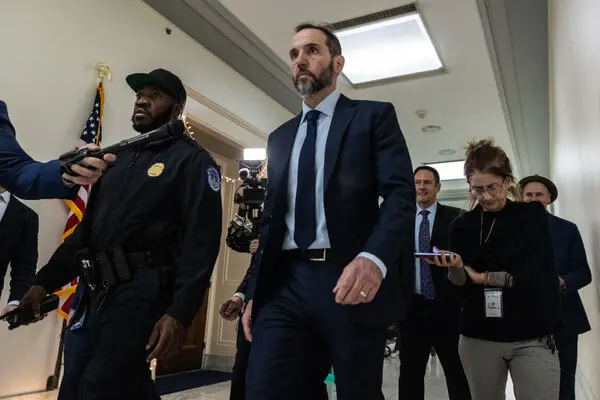
The revelation from former special counsel Jack Smith has sent shockwaves through Republican circles and beyond, as details from his long-running investigation into the events surrounding the January 6, 2021, attack on the U.S. Capitol continue to surface in congressional testimony and public discourse. In recent appearances before the House Judiciary Committee, Smith has forcefully reiterated his findings, emphasizing that the violence at the Capitol “does not happen” without direct involvement from former President Donald Trump and those in his inner circle. The discussion has spotlighted alleged co-conspirators—individuals Trump reportedly trusted and relied upon—who played pivotal roles in what prosecutors described as a coordinated effort to challenge the 2020 election results.
A Long-Simmering Investigation Resurfaces in Testimony
Jack Smith, the former special counsel appointed to examine Trump’s actions post-2020 election, has defended his work in high-profile sessions, including a notable public hearing in January 2026. During these proceedings, Smith described a broad criminal conspiracy aimed at overturning the certified victory of Joe Biden. He portrayed Trump as the central figure, the “most culpable and most responsible person” in the scheme, with actions that foreseeably led to the chaos at the Capitol. Smith stressed that the events of January 6 were not isolated but the culmination of deliberate efforts involving close advisers who advanced false claims of election fraud and pursued strategies to disrupt the peaceful transfer of power.
The names of key figures have long been referenced in indictments and related documents, though Smith clarified in testimony that he had not finalized decisions on additional charges against them before his office’s work concluded. These individuals, drawn from Trump’s trusted legal and political orbit, allegedly helped orchestrate plans ranging from pressuring state officials to assembling alternate electors and influencing the certification process.
Among those repeatedly highlighted are Rudy Giuliani, the former New York City mayor and longtime Trump ally, who was involved in public assertions about widespread fraud and communications tied to the events. Sidney Powell, known for her aggressive legal challenges to the election outcome, was also noted in investigative contexts. Kenneth Chesebro, an attorney credited with developing theories around alternate slates of electors, featured prominently in discussions of strategic memos. John Eastman, a constitutional scholar who advised on challenging the Electoral College count, was described as an architect of certain last-ditch legal maneuvers. Boris Epshteyn, a political strategist and adviser close to Trump, was mentioned in connection with ongoing consultations during the critical period.

These figures, according to Smith’s account, operated in direct contact with Trump, providing counsel and executing plans that prosecutors argued were designed for his benefit. The former special counsel emphasized that evidence gathered—including witness interviews, communications, and documentary records—pointed to a network of trusted aides who enabled the broader effort.
Shock and Division in Washington
The public airing of these details has ignited intense reactions across the political spectrum. In Republican strongholds, the revelations have sparked unease, with some party members expressing concern over the implications for longstanding allies and the ongoing narrative around January 6. Many in conservative circles view the continued focus on these names as part of a partisan vendetta, even as Smith insisted his work followed evidence without regard to politics.
Conversely, among Democrats and independent observers, the testimony has been met with a sense of validation. Longstanding questions about the extent of coordination behind the Capitol events appear answered, with calls for greater accountability echoing through public commentary. The fallout has fueled debates in Washington about the rule of law, the boundaries of executive power, and the durability of democratic institutions.
Smith’s statements underscore a core contention: the assault on the Capitol stemmed directly from efforts to subvert the election outcome, with Trump at the apex and his inner circle executing supporting roles. He noted that the case against Trump relied heavily on testimony from Republicans who had supported him, highlighting how party loyalty was allegedly exploited.
Broader Implications for American Politics
As these revelations reverberate, they underscore the enduring scars of January 6 on the nation’s political fabric. The episode remains a flashpoint, dividing Americans on questions of responsibility, intent, and consequences. With Trump back in the political arena, the discussion of alleged co-conspirators revives scrutiny of those who stood closest to him during one of the most turbulent periods in modern history.
The testimony from Jack Smith serves as a stark reminder of the investigation’s scope and the prosecutor’s conviction that no one, regardless of position, stands above the law. While cases were ultimately dropped due to Department of Justice policy regarding sitting presidents, the record of evidence and public statements continues to shape perceptions of that fateful day and its architects.
The political chaos unleashed by these disclosures shows no signs of abating, as Washington grapples with the implications of a presidency marked by unprecedented legal challenges and the lingering shadow of January 6.

Leave a Reply