NEW YORK — A YouTube video circulating under the headline “Trump Attacks Stephen Colbert — Colbert Flips the Script Instantly!” has racked up attention across social platforms, presenting what it describes as an explosive, unscripted confrontation between The Late Show with Stephen Colbert host Stephen Colbert and Donald Trump.
The problem: there is no independent evidence that the episode, as depicted, ever occurred.
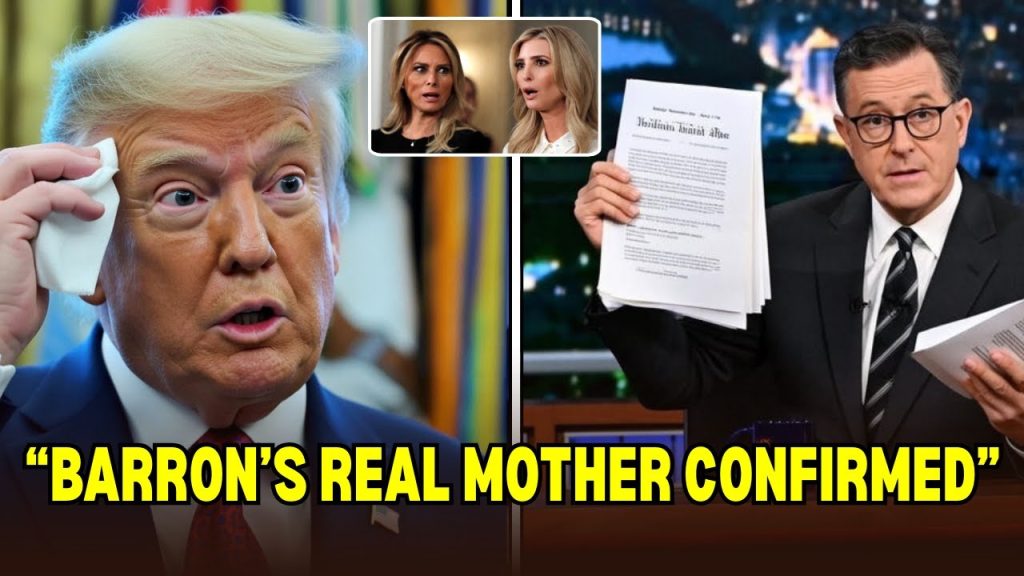
The video — stitched together with dramatic narration, audience-reaction cues, and long stretches of suspenseful storytelling — claims that Mr. Trump appeared unannounced on Colbert’s stage, sparred verbally with the host, and stormed out following a supposed “revelation” involving his family. No broadcast record, network statement, or contemporaneous reporting supports this account.
What the clip offers instead is a revealing look at how political entertainment, misinformation, and algorithmic incentives are increasingly intertwined.
A Familiar Setup, an Unfamiliar Reality
Late-night television has a long history of clashes with powerful figures, and Colbert in particular has built a brand around adversarial satire aimed at Mr. Trump. Real confrontations — monologues, rebuttals, or public insults traded via social media — are well documented.
But media researchers say the video in question borrows the grammar of real late-night moments while inventing the substance.
“It uses all the signals audiences associate with authenticity,” said a professor of media studies at a New York university. “Studio silence. Gasps. A calm host. A rattled politician. But those signals are narrative tools, not proof.”
The video does not include verifiable broadcast footage, timestamps tied to actual air dates, or cross-references to CBS programming schedules. Instead, it relies on a continuous voiceover that describes reactions the viewer is told are happening — a technique more common to fiction podcasts than to journalism.
The Economics of Outrage
YouTube’s recommendation system rewards watch time and emotional engagement. Long, suspense-driven videos that promise shocking reversals perform well, particularly when they involve high-profile political figures.
“This is outrage fan fiction,” said a former network producer who reviewed the clip. “It feels true because it’s emotionally consistent with what people expect Trump–Colbert interactions to be like, even if it’s factually untrue.”
The thumbnail language — “FLIPS THE SCRIPT,” “TOTAL CHAOS,” “TRUMP LOSES IT” — mirrors a broader ecosystem of hyperbolic political content that blends satire, speculation, and invention into a single product.
Why It Spreads

The appeal is not limited to one side of the political spectrum. Supporters of Mr. Trump may share the clip to denounce it as evidence of media hostility. Critics may circulate it as catharsis. In both cases, the algorithm is indifferent to intent.
“The video doesn’t need to be believed to be shared,” the media scholar noted. “It just needs to feel plausible.”
That plausibility is rooted in reality: Mr. Trump has repeatedly attacked late-night hosts; Colbert has repeatedly mocked Mr. Trump. The fiction inserts itself into the gap between those known facts.
The Cost to Public Understanding
CBS declined to comment on the video, citing its policy of not amplifying fabricated content. Representatives for Mr. Trump did not respond to requests for comment.
Still, the episode highlights a growing challenge for audiences. As political entertainment migrates away from traditional broadcast norms and into loosely moderated platforms, the line between commentary and fabrication becomes harder to discern.
“This isn’t satire in the classic sense,” said the former producer. “Satire signals that it’s exaggerating. This signals that it’s revealing.”
A Broader Pattern
The Colbert video is part of a wider trend in which AI-assisted scripts, stock crowd reactions, and authoritative narration are used to manufacture events that never happened, often centered on real public figures.
For journalists, the concern is cumulative rather than singular.
“One fake clip won’t rewrite history,” the media professor said. “But thousands of them, circulating constantly, can distort a public figure’s perceived behavior in subtle ways.”
In the end, the viral video says less about Stephen Colbert or Donald Trump than about the current media environment — one where attention is currency, plausibility is sufficient, and the burden of verification increasingly falls on the viewer.
The real confrontation, it seems, is not between a late-night host and a former president, but between fact-based discourse and a storytelling economy that thrives on spectacle.

Leave a Reply