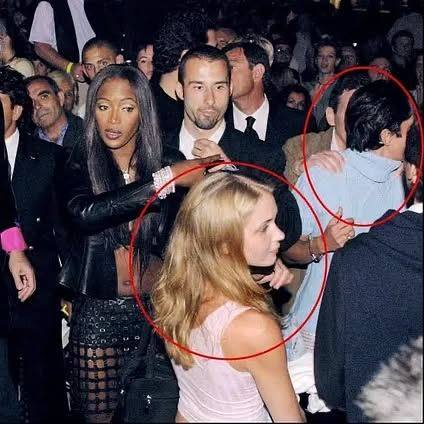
In her memoir, “Nobody’s Girl” Virginia Giuffre writes that she once dined at the same table as Jeffrey Epstein and former President Bill Clinton.
She doesn’t accuse Clinton of abuse.
But she does remind us what complicity looks like — power breaking bread with predators.
Everyone’s talking about Naomi Campbell from the photo of Virginia with Ghislaine Maxwell at Campbell’s birthday party.
But it goes so much higher than models.
The pilots. The security teams. The staff. The friends. The politicians.
Some took part in the abuse.
But they all saw enough to know something was wrong.
And they said nothing.
Giuffre’s memoir isn’t about vengeance.
It’s about memories. And the kind that implicates everyone who helped normalize the unthinkable.
Silence was currency. Access was reward. Virginia’s words are clear.
Complicity isn’t always a crime scene.
Sometimes it’s a dinner party.
Sometimes it’s a flight manifest.
Sometimes it’s the sound of no one saying enough.
And still the real question hangs in the air:
When will the files be released?
When will public hearings be held?
When will the network be exposed and held accountable — the way Virginia always wished?
Virginia Giuffre’s Memoir: Dining with Epstein, Clinton, and the Elite
In her posthumous memoir Nobody’s Girl: A Memoir of Surviving Abuse and Fighting for Justice, Virginia Giuffre offers a deeply personal account of her years entangled in Jeffrey Epstein’s world—exposing not only her trauma but also her proximity to powerful figures. Among the many startling details she recounts, one of the most discussed is her claim that she once shared a dinner table with Epstein and former U.S. President Bill Clinton.
The Dinner Claim
Giuffre writes that she was present at a high-profile dinner hosted by Epstein, where Clinton was also in attendance. According to her account:
- Epstein was seated at the head of the table. Public Intelligence |+2Yahoo+2
- Bill Clinton sat to Epstein’s left, and Giuffre says she sat directly across from Clinton. Yahoo
- At her right, she describes “Emmy Tayler,” Ghislaine Maxwell’s assistant, while Maxwell sat next to Clinton. Public Intelligence |+1
- She notes two “olive-skinned brunettes” who had flown in from New York, who she believed were very young, though she did not say Clinton showed sexual interest in them. Yahoo+1
- Despite the setting, Giuffre does not explicitly allege any sexual misconduct by Clinton in her memoir. Yahoo
Context and Interpretation
This anecdote is not presented by Giuffre as an isolated dinner but as part of a broader portrait of Epstein’s inner social circle—one that included world-class elites, celebrities, and political heavyweights. Her purpose appears twofold:
- Exposing Epstein’s World: By mentioning dinners with prominent people, she underscores how Epstein moved in very powerful social circles, lending credibility to how he built his influence and access. Newsweek
- Highlighting Her Position: Her presence at such events reflects the disturbing normalization of her role within that privileged orbit—sometimes as a young, vulnerable girl in a room full of the elite. The Guardian
Reception and Fact-Checking
- Publisher & Legal Vetting: Her memoir was “vigorously fact-checked and legally vetted,” according to her co-author, Amy Wallace. The Guardian+1
- No Accusation Against Clinton: Multiple outlets (e.g., Newsweek) note that while Giuffre mentions meeting Clinton, she makes no claim of abuse or sexual misconduct by him. Newsweek
- Skepticism and Verification: Some readers and analysts have raised questions about certain details—especially given prior disputes over Epstein flight logs and island visits. Public Intelligence |
- Emotional Weight: Reviews (e.g., in The Guardian) highlight how Giuffre’s portrayal of “casual visitors” at Epstein’s dinner parties forces readers to reckon with the normalization of abuse in elite social settings. The Guardian
Why This Matters
Giuffre’s dinner-table claim is significant not because she accuses Clinton of a crime, but because it illustrates:
- The reach of Epstein’s influence: How someone convicted of trafficking could nevertheless socialize with powerful figures in a seemingly benign way.
- The dissonance between appearances and reality: Even in settings that looked like high-society dinners, dark power dynamics were at play.
- Her courage in naming her experience: By recording these encounters, she helps demystify Epstein’s connections and challenges the narrative that his network was purely philanthropic or innocuous.
Broader Implications
Giuffre’s revelations contribute to broader public and legal conversations about Epstein’s legacy. They raise uncomfortable questions: What did influential people know? What was their relationship with Epstein really like? And how do we reconcile social privilege with systemic abuse?
If you like, I can write a news-style summary of this specific episode (for social media or a newsletter) — do you want me to do that?

Leave a Reply