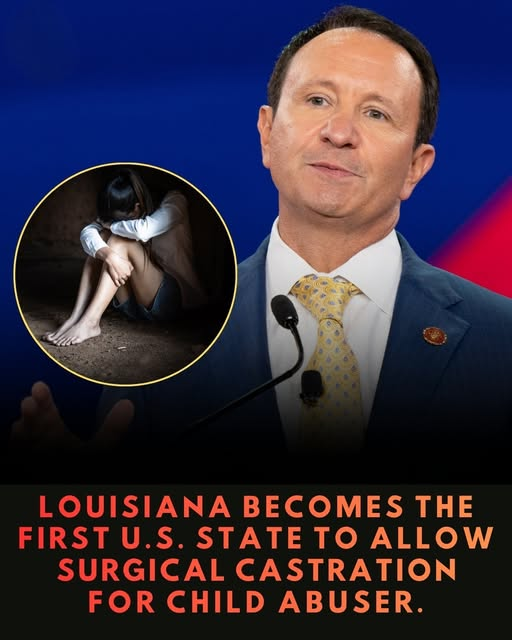
Louisiana has made a significant and controversial step in the fight against child sex crimes by becoming the first state in the U.S. to introduce surgical castration as a legal penalty for certain offenders. Signed into law by Governor Jeff Landry, Act 651 aims to address the growing concerns over the safety of children by mandating permanent castration for individuals convicted of severe sex crimes against children under the age of 13. While the law has been met with support from those advocating for harsher punishments for child predators, it has also sparked considerable debate regarding its constitutionality and ethical implications. This article will delve into the specifics of the law, its potential implications, and the ongoing debate surrounding its effectiveness and fairness.
Overview of Act 651: The Introduction of Surgical Castration
On August 1, 2024, Louisiana became the first state to enact a law that mandates surgical castration for individuals convicted of certain severe sex crimes involving children under the age of 13. Governor Jeff Landry’s signing of Act 651 marked a pivotal moment in the state’s approach to child sex offenses. Under this law, individuals convicted of aggravated rape or other severe sex crimes against minors will be subjected to permanent castration, regardless of whether they undergo the procedure voluntarily. Furthermore, offenders who refuse to comply with the procedure will face additional prison sentences. The law is designed to address the need for more stringent measures to protect children from sexual predators, particularly those with a history of committing heinous acts.
While surgical castration is a central aspect of Act 651, the law also includes provisions that require a thorough review of the offender’s mental state, ensuring that the procedure is only performed on those deemed fit for it by medical professionals. This review process includes a determination of the offender’s likelihood of reoffending, taking into account their history, psychological evaluations, and risk factors.
Support for Act 651: A Strong Statement on Protecting Children
Proponents of the law argue that it is a necessary step to protect vulnerable children from sexual predators who pose a continued risk to society. Child sex offenses, particularly those involving young children, have long been a source of concern for lawmakers and child advocacy groups alike. Supporters of Act 651 contend that the law sends a strong message to offenders, illustrating that there are serious consequences for those who engage in such heinous acts. They assert that surgical castration is a means of permanently removing the offender’s ability to perpetrate sexual violence, thereby ensuring greater protection for future generations of children.
The law’s supporters also point to the increasing number of repeat offenders as evidence of the need for more extreme measures. Studies have shown that individuals convicted of sex crimes against children often exhibit a high risk of reoffending, and some experts believe that harsher punishments are necessary to break the cycle of abuse. Supporters believe that, by mandating surgical castration, Louisiana will significantly reduce the likelihood of recidivism among convicted offenders, ultimately leading to a safer environment for children across the state.

Criticism and Legal Challenges: Concerns Over Constitutionality
Despite its strong support from certain sectors, Act 651 has faced significant criticism, particularly concerning its potential violation of constitutional rights. Critics argue that the law represents a form of cruel and unusual punishment, which is prohibited under the Eighth Amendment of the U.S. Constitution. Opponents claim that surgical castration is an irreversible and extreme measure that infringes upon the rights of the offender, and that the punishment is disproportionate to the crime. They also raise concerns about the psychological and physical harm that may result from the procedure, particularly if it is performed on individuals who may not have a high risk of reoffending.
Criticism and Legal Challenges: Concerns Over Constitutionality
Despite its strong support from certain sectors, Act 651 has faced significant criticism, particularly concerning its potential violation of constitutional rights. Critics argue that the law represents a form of cruel and unusual punishment, which is prohibited under the Eighth Amendment of the U.S. Constitution. Opponents claim that surgical castration is an irreversible and extreme measure that infringes upon the rights of the offender, and that the punishment is disproportionate to the crime. They also raise concerns about the psychological and physical harm that may result from the procedure, particularly if it is performed on individuals who may not have a high risk of reoffending.
Additionally, the law’s requirement that offenders who refuse the procedure face additional prison time has raised questions about involuntary medical treatment. Opponents argue that forcing someone to undergo surgery against their will could be seen as a violation of their right to bodily autonomy. The legal battle surrounding the constitutionality of Act 651 is likely to continue, with several civil liberties groups and legal experts indicating that they will challenge the law in court.
The debate over the law’s constitutionality also extends to the ethical concerns surrounding the procedure itself. Critics contend that medical professionals should not be compelled to perform a procedure that they may find morally objectionable or that could cause long-term harm to the individual. The ethical implications of such a drastic measure are not easily resolved, and the law’s potential to set a precedent for similar legislation in other states has sparked widespread concern among human rights advocates.
The Impact on Rehabilitation and Reform
One of the primary goals of the criminal justice system is rehabilitation—helping offenders reintegrate into society in a way that prevents them from reoffending. Opponents of Act 651 argue that surgical castration fails to address the underlying issues that drive individuals to commit sex crimes. They believe that focusing solely on punitive measures such as castration overlooks the need for psychological treatment and rehabilitation programs that can help offenders understand and control their impulses.
Some experts suggest that a more effective approach to reducing child sex crimes would involve comprehensive rehabilitation programs, including therapy, counseling, and behavior modification. These programs, which focus on addressing the root causes of criminal behavior, could help offenders better understand the harm they have caused and provide them with the tools to reintegrate into society successfully.
Furthermore, critics argue that the law’s focus on physical punishment, rather than psychological intervention, could perpetuate a punitive mindset within the criminal justice system, rather than one that seeks to address the complex nature of sex offenses. They also point to studies showing that the effectiveness of surgical castration in preventing reoffending is inconclusive at best, with some experts questioning its long-term impact on offender behavior.

The Role of the Public in the Debate
The enactment of Act 651 has stirred strong opinions on both sides of the issue, with public opinion remaining divided. On one hand, there are those who strongly support the law, viewing it as a necessary measure to protect children and ensure that offenders face harsh consequences for their crimes. On the other hand, there are those who believe that the law’s punitive approach is misguided and that it fails to address the underlying issues of child sexual abuse.
The debate over surgical castration reflects broader societal concerns about how to balance justice with compassion, punishment with rehabilitation. As Louisiana becomes the first state to enact such a law, other states may be watching closely to see how it impacts the state’s criminal justice system and whether similar measures will be introduced in their own legislatures.
Conclusion: A Landmark Law with Far-Reaching Implications
Louisiana’s introduction of surgical castration as a legal penalty for child sex offenders marks a significant moment in the ongoing battle to protect children from sexual predators. While Act 651 has been praised by some for its tough stance on child sexual abuse, it has also faced considerable criticism regarding its potential constitutional violations and ethical concerns. The law’s future will likely be shaped by legal challenges, ongoing public debate, and the broader conversation about how to balance punishment and rehabilitation within the criminal justice system.
As Louisiana leads the way in introducing this controversial measure, the country will continue to grapple with the difficult question of how to best protect children while ensuring that the rights of offenders are respected. The outcome of this debate will have lasting implications for both the criminal justice system and the future of child protection laws across the United States.


Leave a Reply